
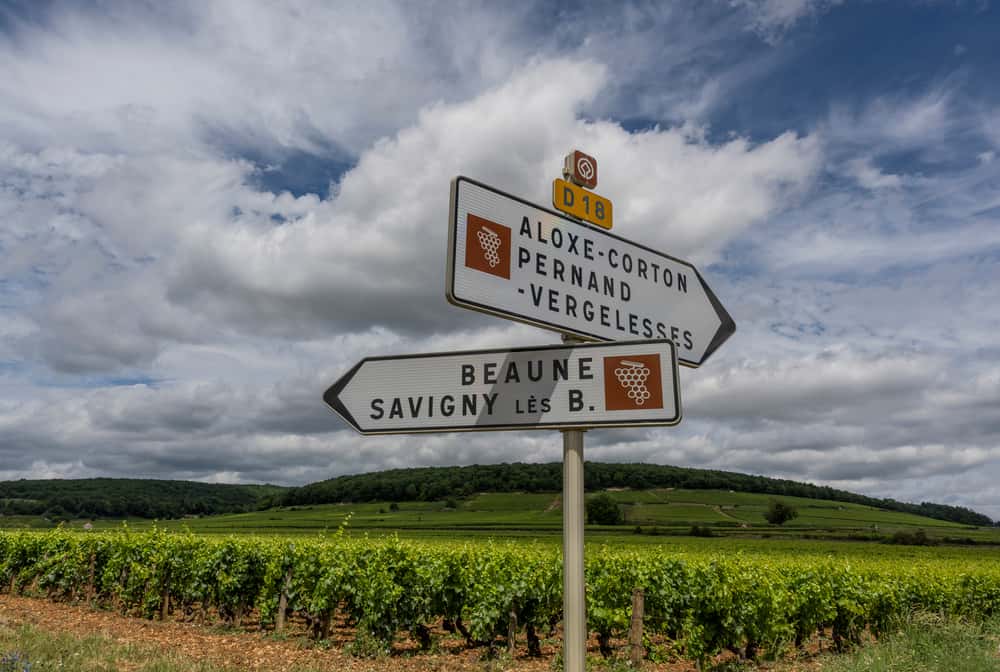
Aloxe-Corton WIne Region Guide
The production of consists of Aloxe-Corton appellation almost is red wine, it is around 98 per cent, and just around two per cent are white wines
About Aloxe-Corton
- Classification
- AOP Aloxe-Corton
- Grape Focus
- Pinot Noir for red wines and Chardonnay for white wines
- Wine Types
- Red Wine, White Wine
Aloxe-Corton is a wine appellation in the northern side of Côte de Beaune, a subregion of Burgundy. The vineyards are spread across 118 hectares and cover the communes of Aloxe Corton and Ladoix-Serrigny. Aloxe-Corton wine appellation boasts 14 climats classified as Premier Cru and 3 Grand Crus. The appellation is dominated by red wines that account for 98%, and only 2% of the total production is white wines. The appellation produces 4301 hectoliters of red wines and 81 hectoliters of white wines corresponding to 600,000 bottles of red and 10,000 of white.
Check out the best wine tastings and tours in Aloxe-Corton!
Where is the Aloxe-Corton wine region?
Aloxe-Corton lies on the plains of Cote d’Or escarpment, on the northern side of the Côte de Beaune region of Burgundy. The south and east side of Corton hill lies in the commune of Aloxe-Corton, and the northeast side is part of the commune of Ladoix-Serrigny. The Aloxe-Corton wine appellation accounts for 118 hectares of vineyard out of which 115 hectares are planted with Pinot Noir and only 3 hectares are planted with white varietals. The appellation is surrounded by Chorey Les Beaune from south to southeast, Savigny Les Beaune from the southwest, and Magny Les Villers from North.
History of the Aloxe-Corton wine region
The Aloxe Corton received the status of Appellation d'Origine Contrôlée in 1938. Red wines dominate the region with 98% of total production whereas white wines only account for 2%. In the 19th century, the “Corton” was already a familiar name among the burgundy wine community. So, in the mid-19th century, the “Corton” was added to “Aloxe” resulting in its name.
The terroir and geography of the Aloxe-Corton wine region
Aloxe-Corton wine appellation boasts 14 Premier Crus and 3 Grand Crus among the communes of Aloxe-Corton, Ladoix Serringny, and Pernard Vergelesses. The vineyards are situated between 200-300 meters above sea level. The soil comprises flint and limestone debris rich in potassium and phosphoric acid making the soil reddish brown. There is also pebbly clayey soil with marl limestone in some areas. The grapes with east exposures are much tender with a fruity aroma while the southern grapes are more complex.
Popular grape varieties from the Aloxe-Corton wine region
The Aloxe-Corton wine appellation is known for powerful Pinot Noir that is well structured yet highly refined. The appellation allows winemakers to add up to 15% of Chardonnay, Pinot Blanc, and Pinot Gris for the production of red wines. The white wines are usually 100% Chardonnay and sometimes Pinot Blac is used as accessory grapes. Tender and fruity, this wine reaches its peak after 3 to 5 years in the cellar, revealing a firm and well-built body, richly chewy and with pleasing tannins.
Food to pair with Aloxe-Corton wine
Bœuf bourguignon
Beef bourguignon is a slowly-cooked beef stew traditionally made in the French cuisine using wines of burgundy. The dish is typically made with beef, onion, carrots, celery, and flour. The beef is browned in butter or oil before being added to the other ingredients. Bœuf bourguignon is often served with boiled potatoes or pasta
The dish is not a regional recipe from burgundy rather use of wine explains the name. The dish was first recorded in 1867, often made with leftover meat. The dish was recognized as a Burgundian specialty at the beginning of the 20th century.
The flavors of the dish are rich, complex, and hearty thanks to the long cooking time. The bold Aloxe-Corton wines perfectly pair with this dish.
Fondue Bourguignonne
Fondue Bourguignonne originated from Switzerland although the name sounds French. The dish calls for tender beef that is cut in a cubed shape. The meat is seared in butter and served along with dipping sauce.
The dish was invented by swiss farmers who prepared meals in the field. The farmers cooked pieces of meat in a pot of oil during their break. The dish is usually prepared with beef but the modern version also includes pork, chicken, liver, and various vegetables.
Lobster Thermidor
The Lobster Thermidor is a stunning french dish that is surprisingly easy to make that goes perfectly with dry and crisp Meursault. The lobster shells are stuffed with a cooked tender chunk of lobster in a creamy rich wine sauce, topped with parmesan cheese, and browned.
There are two stories of how the dish was named. One of the popular is that it was named by Napolean after the month he first ate it. The month of Thermidor was July 19 to August 17 according to the French revolutionary calendar. Another story is that the dish was first prepared in 1894 at Maire’s Restaurant in Paris. Lobster thermidor is named after a premiere of Victorian Sardou’s play, Thermidor, which was playing at the theatre Comédie Française, near which the restaurant was located. Pair it with Corton Charlemagne for the best experience.
Places to visit in the Aloxe-Corton wine region
Musée de l'Hôtel-Dieu - Hospices de Beaune
Hospices de Beaune is a former hospital built in 1443 by then chancellor of Duke of Burgundy. It is one of the most prestigious historical monuments in France. The courtyard flaunts a flamboyant roof with varnished tiles of that era which is emblematic of Burgundy. You can take a tour of this classic historical heritage along with an audio guide that will walk you across the centuries. Although the building is converted into a Museum, and cultural shop the original mission of taking care of the sick still continues. It also has 60 hectares of vineyard and produces amazing wines that are actioned every third Sunday of November. The funds collected from sales are used for charities.
Chateauneuf-en-Auxois
The village of Chateauneuf-en-Auxois is listed as one of the most beautiful villages in France. The village is just 30 km southwest of Dijon of Burgundy. The village has been an important stop-over point for a pilgrimage route. The village lies atop a hill with beautiful castles and a fortress. The oldest castle dates back to 1132 and was built as a fortress. The village is surrounded by substantial towers and heavy walls in the 14th century. The village offered accommodation since the 15th century for travelers. Most of the buildings in the village are fine merchant houses from the 12-14th century, constructed in the yellow-white stone procured locally.
Frequently asked questions about Aloxe-Corton
Aloxe-Corton lies on the plains of Cote d’Or escarpment, on the northern side of the Côte de Beaune region of Burgundy. The south and east side of Corton hill lies in the commune of Aloxe-Corton, and the northeast side is part of the commune of Ladoix-Serrigny. The appellation is surrounded by Chorey Les Beaune from south to southeast, Savigny Les Beaune from the southwest, and Magny Les Villers from North.
Chateau Corton C.
Domaine Comte Senard
Caveau d'Aloxe Corton
Domaine Follin-Arbelet
Domaine Maurice Chapuis
Domaine Antonin Guyon Les Fournieres, Aloxe-Corton Premier Cru, France
Domaine Tollot-Beaut Les Fournieres, Aloxe-Corton Premier Cru, France
Arnoux Pere & Fils Les Fournieres, Aloxe-Corton Premier Cru, France
Lupe-Cholet Domaine du Chateau Gris Les Fournieres, Aloxe-Corton Premier Cru, France
2015 Domaine Faiveley Corton ‘Clos des Cortons Faiveley’ Monopole Grand Cru
The wine appellation is mostly dominated by Pinot Noir. The total production of red grapes accounts for 98% and white grapes are 2%.
Red Varietals: Pinot Noir
White varietals: Pinot Gris, Pinot Blanc, Chardonnay
The Pinot Noir wines from Aloxe-Corton are dark with their shade varying from deep ruby to garnet. Young red wines have aromas of red and black fruits that build up with age giving floral notes. The wines are well structured and powerful, these wines are better served after 3 to 5 years with silky tannins and an aromatic profile of leather, truffle, mushroom, cinnamon, and dry fruits.
Tailor-Made For You
Your perfect wine trip, planned for you
Tell us what you're dreaming of and a local wine expert will build a personalized itinerary — no obligation, no service fee.
Join our newsletter now to receive our free guide on how to plan the perfect wine tour.