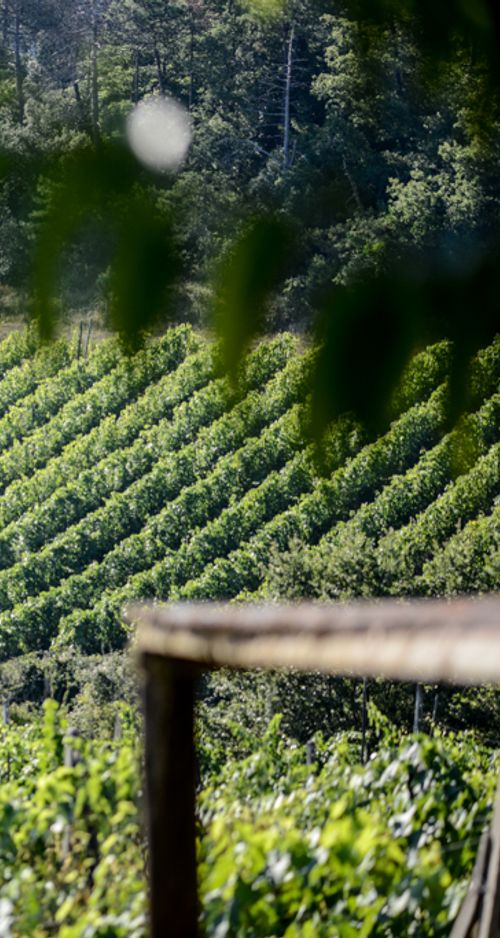
We always called the little vineyard consisting of 700-800 vines in the top part of the estate “Beppone’s vineyard”.
Beppone was the last of the farm’s sharecroppers who tended this vineyard until 1980, aged ninety.
Only years later did we understand why Beppone spent most of the day, from the crack of dawn, in that vineyard
from the end of August until harvesting.
The grapes were very sweet and ripened three weeks earlier than the others. Therefore, they were prey to birds from
the surrounding wood. He was aware of this and guarded the crop. In actual fact, in recent years the vines have
produced very few grapes for harvesting due to their age: they were probably planted in the forties by the previous
owner. In 1997 we had to dig up plots to gradually renew vineyards. We also thought of digging up Beppone’s
vineyard due to its age and low yield.
That year we walked around Beppone’s vineyard, which contained approximately 80-100 kilos of grapes. We noted
that the vine leaves were very strange for a Sangiovese and more like a Cabernet or Merlot. The grapes were very
sweet and brightly coloured, almost ink-coloured, but not as herbaceous as Cabernet.
Out of curiosity, we decided to make wine separately from those few bunches.
Baldo, the farmer, took care of that demijohn of wine. We tasted it towards December: it was very dark, dense,
purplish, highly tannic and had an almost unpleasant, tar taste.
We thought it wise to uproot that vineyard. As Cambiotti used to say, those grapes were only used to colour the rest
of the wine. However, it was not colorino.
In March of the following year, we met Baldo again and he told me that he had a surprise for us and showed us the
demijohn that he was supposed to remove but which he had in actual fact continued to decant and keep aside.
We tasted the wine once again and was amazed at its marvellous taste and special bouquet. We understood that it
was a thoroughbred. We ordered that Beppone’s little vineyard be dug and well tended. In January 1999, we grafted
approximately 7000 vine cuttings, which were then planted in February 2000. Other 8000 plants were planted in the
year 2008, in the month of March and other 2000 in the year 2010. Today are more than 30.000
At the same time, we had started experimenting on the product obtained from the old vineyard, corroborating the
extraordinary quality of that species of vine in that earth and then raising its qualitative standards.
Naturally, we were curious to find out what species of vine it was. It was definitely not sangiovese, colorino, merlot or
cabernet.
In order to find out, Prof. Scienza of Milan University conducted a three years studing, a genetic research to
corroborate that it is a new species of vine.
At present this studing finished, the grape is unknown as there is no genetic correspondence between “Beppone” and
known species of vines catalogued in data banks.
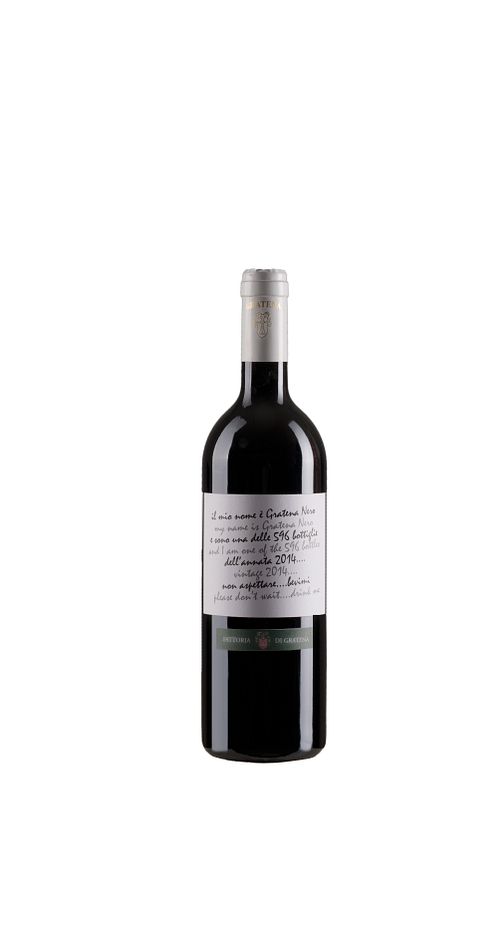
This new grape without any DNA was omologated by the Ministery with the name "GRATENA NERO" and now since
September 2017 is officially registered as a new Tuscan Grape and they said that is a blend of Cabernet Franc and
Barbera. Further studies in the year 2018 said that Gratena Nero has the same genetic heritage as Incrocio Terzi 1, a
vine planted in very few plants around the city of Bergamo, infact the last owner of Gratena, before my grandfather,
was from Bergamo.
However the Gratena Nero remains Tuscan and in this bottle is 100%.
Enjoy with our wines

 Organic
 Natural