
€12.00
·
4.8
·
24 reviews
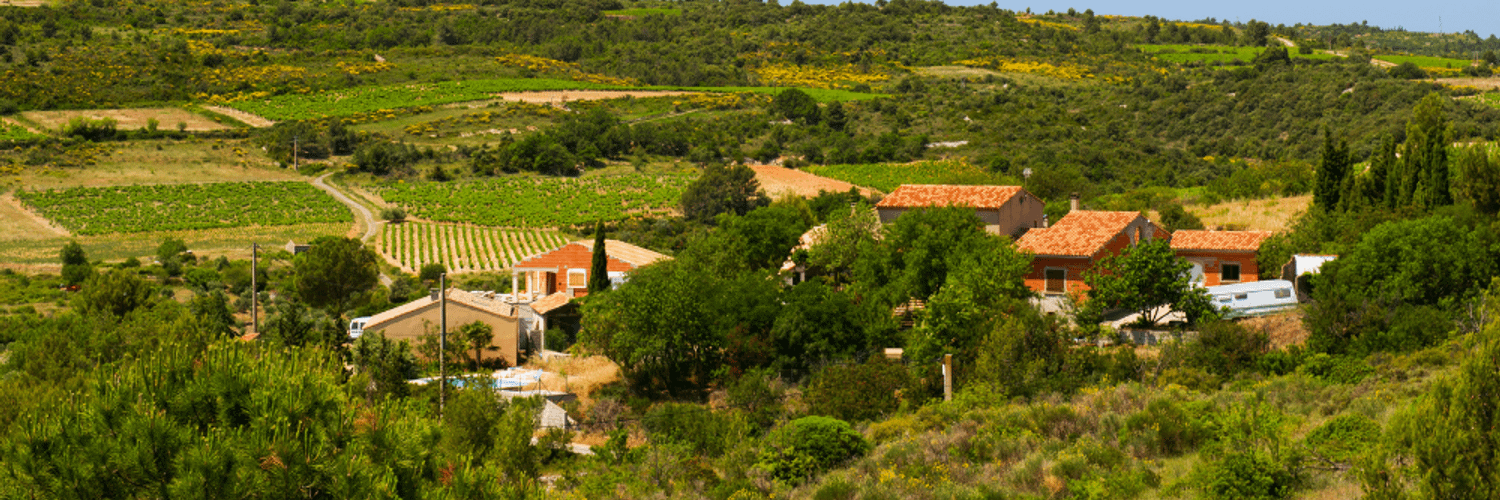
Coteaux du Languedoc, located in the southwestern corner of France, invites wine enthusiasts to explore its diverse vinous landscapes. This subregion is celebrated for its rich array of indigenous grape varieties, including Grenache, Syrah, and Mourvèdre, which shine in both robust reds and refreshing whites. Venture into picturesque villages like Pic St. Loup and Faugères, where family-owned wineries offer intimate tasting experiences, and uncover the region's blend of cultural heritage and stunning vistas that make wine tourism here truly special.
Located in the Languedoc-Roussillon wine region, Coteaux du Languedoc wine appellation is famous for high-quality French wines. It is stretched from Nîmes in the east to Narbonne in the west. The appellation produces popular red, white, and rosé table wines, which account for about a third of all French wine made. I really recommend you go to this place if you're looking for a place with great wine and food. Oh, and it's guaranteed that you will never see anything more beautiful in your life.
Discover Wine Tastings and Tours in Coteaux du Languedoc
Coteaux du Languedoc appellation is located in France, near the city Montpellier and Narbonne. It stretches from the Rhône Valley to the Spanish border in the southwest.
This area is famous for its rich history, culture, and wine-producing traditions. The Coteaux du Languedoc is part of the large Mediterranean coastal area, which is known as the Occitanie region.
Coteaux du Languedoc’s grace and finesse are primarily due to the area's winemakers and their incredible attention to detail in their methods. These elements help to shape a style of wine found nowhere else in France or the world for that matter. Indeed, the area covered by Coteaux du Languedoc is large, thus, is subdivided into the following sub-appellations:
The wine-making history of Coteaux du Languedoc goes back to the 5th century BC when Greeks first introduced viticultural methods to the people of this area. Later, winemaking expanded under the governance of Romans, as it happened to numerous other French wine regions. After that time, viticulture became a vital part of this territory and played an essential part in the development of the economy.
In the 17th century, the construction of the Canal du Midi opened the route from the Mediterranean to the Atlantic, which helped the wine spread out from Languedoc.
In 1868 Phylloxera began attacking the Languedoc appellation. So, they grafted the vines onto phylloxera-resistant American rootstock, which increased the quantity of production. By 1900, the annual harvest was 21 million hectoliters.
In the 19th century, a railway system was created that made it a lot easier to transport wine all over France. This is the period when the Languedoc wine became even more popular.
The first AOC was established in the Languedoc region as Blanquette de Limoux, which received the status in 1938. In 1945 the Languedoc received recognition from the National Institute of the Appellations of Origin (INAO) as Wine of Superior Quality (VDQS) and started labeling its wines.
The 20th century was a little tough for winemakers from this appellation because of the increased production and poor quality. However, 21 century seems to be the new era for this place as they are more focused on quality and new techniques.
Most of the vineyards in the Coteaux du Languedoc appellation are seated on hillsides or terraces. The soil types vary from volcanic to gravel and sand or loam characteristics. Thankfully, the long-established grape varieties have adapted to the diverse terroir of this place.
With the surrounding garrigue-scrub landscape consisting of rosemary, lavender, thyme, juniper, bay, and other plants, the vineyards became part of unique scenery.
The Mediterranean-influenced climate plays a vital role in the shaping of the region's unique terroir. The Mediterranean climate with hot summers, mild springs, autumns, and winters, provides consistency across vintages. Also, regional winds from the north and west provide consistent cooling, which helps the vineyards to cool down in the hot summer.
The Coteaux du Languedoc region receives little rainfall, and in some areas, the amount of rain is the lowest in all of France. However, the Languedoc has reserves of water in most of its calcareous soils. So, the grapes still get the required amount of water and develop well.
Check out our list of wineries in Coteaux du Languedoc to discover more.
Languedoc’s AOC red wines are exclusively made with Grenache, Syrah, Carignan, Mourvèdre, and Cinsault. Their flavors are dominated by red fruits and spices and are often mixed with garrigue, thyme, lavender, containing rosemary, sage, and juniper.
Red wines are the most produced wines in the region, with 60 percent of the Languedoc’s total production. Then comes the white wines with 20 percent of production, and Rose wines with 20 percent.
The Grenache is a grape variety that has been cultivated in France since the Middle Ages. Grenache provides structure to Languedoc blends, and it's mostly smooth and delicate. It has a very aromatic flavor and the ability to age well. Grenache is often combined with more tannic grapes, such as Mourvèdre and Syrah.
The Syrah grape gives wines high alcohol and tannins, which allows wines to age well. Syrah produces low-acid, fruity, and deeply colored wines with red fruit and strong floral notes. Also, some wines have hints of ginger, licorice, and spice.
Carignan produces powerful, intensely colored wines with strong tannins. This grape variety is mostly grown in the southern Mediterranean. Wines produced from Carignan are full of red and black fruit notes as well as notes of garrigue. This grape is mostly mixed with Grenache, Cinsault, Syrah, and Mourvèdre.
The history of this grape variety starts from the Middle Ages. Mourvèdre produces full-bodied, bold, tannic wines that are firm in structure. This grape gives the wine flavors of blackberries, blueberries, black currant, and herbal garrigue.
Cinsault grape variety is famous for juicy, and fruity wines, that mostly have light ruby colors. Wines from this grape variety have the notes of sour red berries, like strawberries, cranberries, and currants.
Cassoulet is a traditional dish from the southwest of France. It is made with beans and meat and comes from three popular variations. The name Cassoulet comes from the previous dish Cassole, which is the ancestor of the new meal.
The meat and beans are braised at a low temperature in the terracotta until they become soft enough to melt in your mouth. Every city of this region argues that they have the original recipe of this dish, but they all agree that this dish is held sacred in the Coteaux du Languedoc wine region.
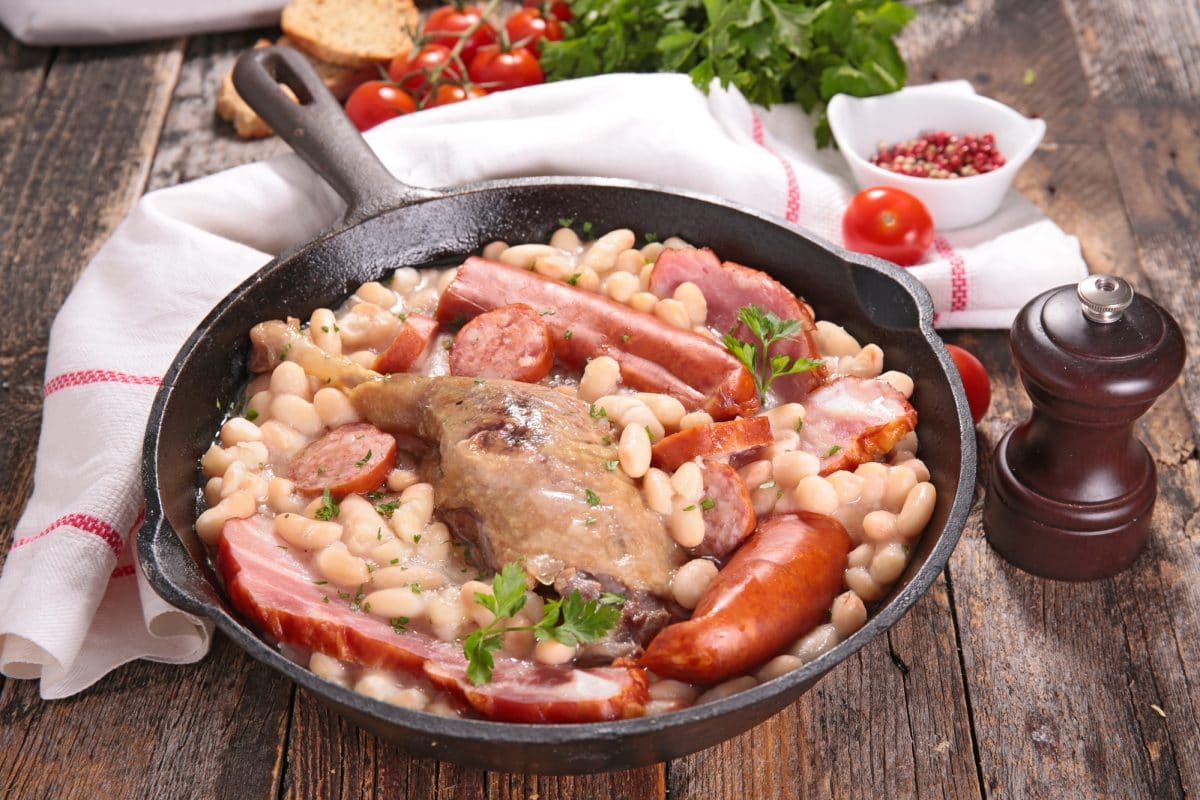
This French food is best enjoyed on a cold winter day, and it is recommended to accompany it with a glass of Coteaux du Languedoc wine.
Bourride is a popular fish stew originating from the French region of Languedoc-Roussillon. It is mostly made with white fish such as Mackerel, Mullet, or Sea Bass, but the most traditional recipes primarily include Monkfish. The stew is usually enriched by vegetables such as onions, leeks, celery, and carrots.
Although there are numerous varieties of the Bourride, it is believed that the dish comes from the Sète, a port city in southeastern France. It is mostly served on the side of the bowl where it is combined with the creamy broth and the accompanying fish. It is recommended to taste this dish with a glass of Coteaux du Languedoc wine.
Clapassade is a traditional French dish from southern France. This dish can be prepared in many variations, but all of them contain the primary ingredients: olives, honey, lamb, and star anise.
When Clapassade is cooked, it has a licorice undertone with a slight sweetness coming from the honey. Also, in the process of cooking, white wine is usually added as a deglazing. Finally, the whole dish is garnished with grated lime.
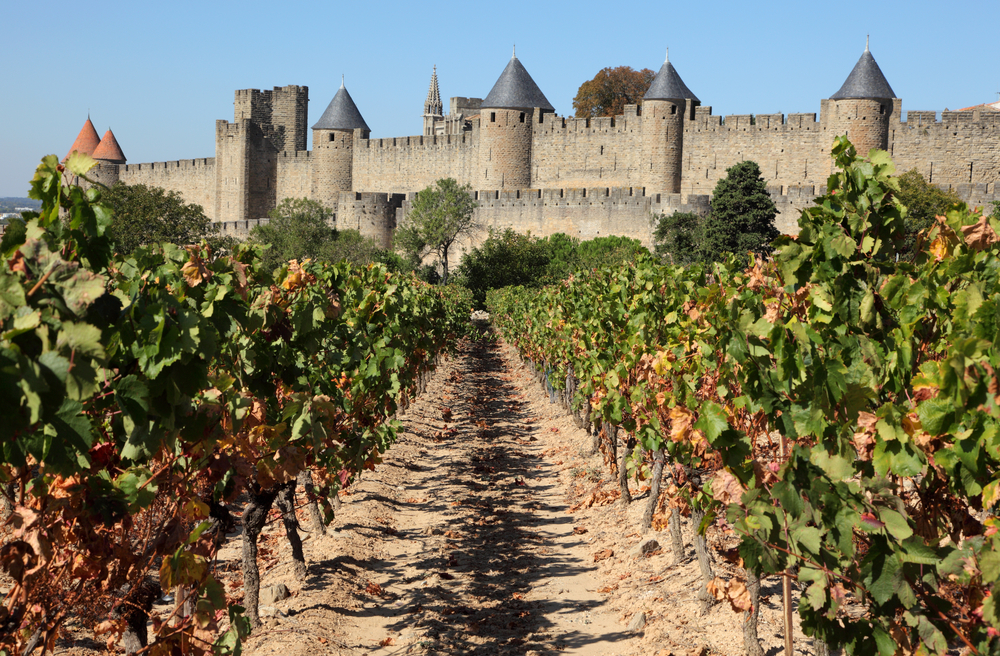
The UNESCO-listed Cité de Carcassonne is a citadel, perched on a hilltop. This incredibly well-preserved medieval city, known as the Cité de Carcassonne, lets the visitors travel back in time.
The main entry gate into La Cité is the imposing Porte Narbonnaise with towers from the 13th century. Also, there is the Basilique Saint-Nazaire et Saint-Celse, which was built in the 10th and 14th centuries. During summertime, Carcassonne hosts many cultural events, so it is the perfect time to book a tour around this magnificent area.
With its balmy weather, luxurious buildings, and public squares, Montpellier is a popular tourist destination of the Coteaux du Languedoc region. This town belonged to the Kings of Aragon in the 13th century. It was the headquarters of the Huguenots in the 16th century and is still the center of the region.
The city boasts a wealth of art galleries and museums. For example, The Musée Fabre has a collection of paintings by French, Italian, and Dutch artists from the Renaissance era up to the 19th century. In addition, the town looks like an open-air museum itself.
Perpignan is a Mediterranean town with red-tile roofed buildings and palm trees. You can feel a distinct Spanish influence there because of the proximity to the Pyrenees Mountains that border Spain.
Le Castillet, a 14th-century fortified tower, was once the main entrance gate into the town. The only remaining portion of the old ramparts, Le Castillet is Perpignan's most emblematic landmark.
Another must-see attraction is the Cathédrale Saint-Jean-Baptiste, which was built in the 14th and 15th centuries. The cathedral has an ornately decorated interior. However, the most notable features are the 16th- and 17th-century reredos.
Just getting started on your wine journey, or jumping back in?
Look through our collection of great wineries
Displaying 1-10 of 31 wineries


Just getting started on your wine journey, or jumping back in?
Look through our collection of great wineries


Discover the locations of wineries in Coteaux du Languedoc
Join our newsletter now to receive our free guide on how to plan the perfect wine tour

